
Football fans crossed borders, chased fixtures and found unfamiliar bathrooms. We followed the anonymous Poop Map trail left around the 2026 World Cup host cities.
From the opening match on 11 June to the final on 19 July, the 2026 World Cup sent supporters across three countries and 16 host cities. Naturally, some of them brought Poop Map along for the ride.
The away squad: 344 apparent travelers
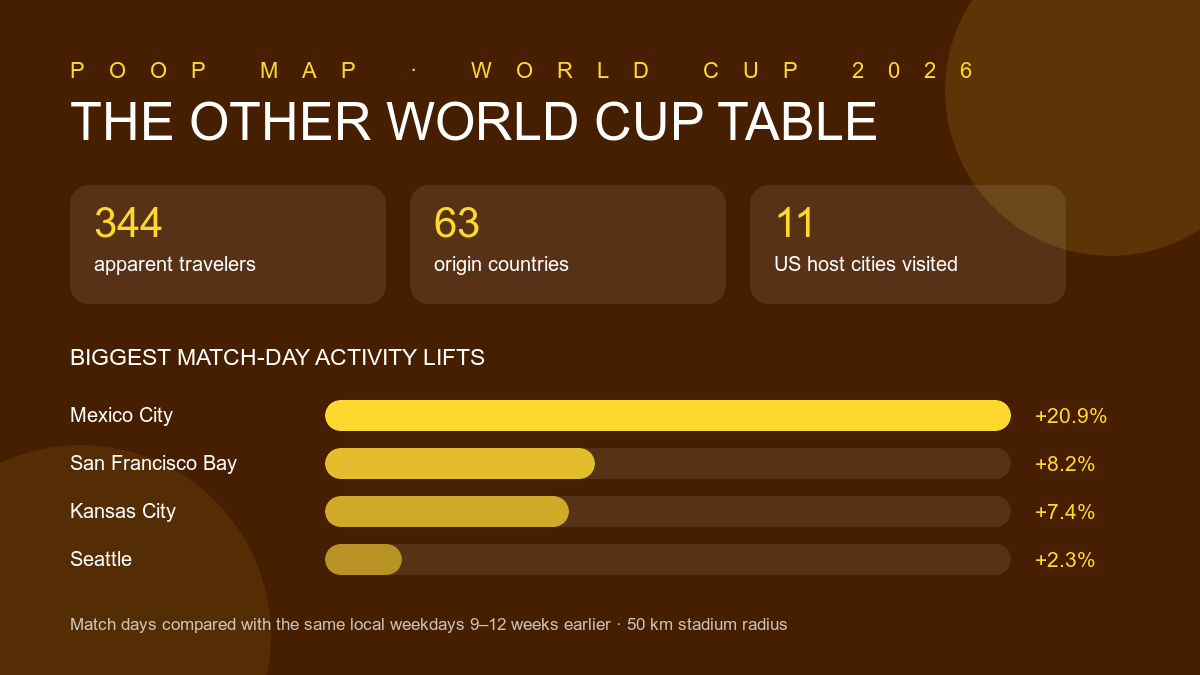
We identified 344 apparent international travelers who dropped a pin near a United States host stadium on a match day. Together, they came from 63 home countries and reached all 11 US host cities.
For this count, an apparent traveler needed at least three located poops before the tournament, a usual pre-tournament country outside the US, and a tournament drop within 50 kilometres of a US host stadium on one of its match dates. It is a sign of travel, not proof that somebody held a ticket or attended the match.
Canada supplied the largest share of the away squad at 13.1%, narrowly ahead of the United Kingdom at 12.2%. Spain followed at 7.8%, France at 6.7%, and Australia and Italy shared fifth place at 5.8% each.
New York won the travel table
New York New Jersey attracted the most apparent international travelers, so we gave it a Traveler Index of 100:
- New York New Jersey — 100
- Los Angeles — 53.7
- Boston — 51.9
- Miami — 32.4
- Dallas — 27.8
Kansas City finished at the other end of this particular table with an index of 4.6. That does not say anything about the football or the city—only where this small, trackable group of traveling Poop Map users left pins.
Mexico City takes the match-day trophy
To look for a match-day effect, we compared activity within 50 kilometres of each stadium with the same local weekdays nine to twelve weeks earlier.
Mexico City recorded the clearest lift: activity was 20.9% higher on its match days. The leading US host cities were San Francisco Bay Area at +8.2% and Kansas City at +7.4%. Seattle followed at +2.3%, Houston at +2.0%, and Dallas at +1.9%.
Not every host city moved upward. Across the United States as a whole, Poop Map activity during the 39 tournament days was actually 2.1% lower than during the preceding 39 days. Average ratings changed by just -0.01, while the share of poops receiving a like did not change at all.
In other words, there was no nationwide World Cup poop boom. The interesting movement was local: travelers appearing in host cities and a handful of stadium areas getting busier on match days.
A note from the video assistant referee
These are anonymous patterns in Poop Map activity, not medical findings or confirmed travel records. A stadium-area pin could belong to a ticket holder, somebody at a fan event, a local resident or a person who had no interest in football whatsoever. The comparison tells us what happened around the tournament; it cannot prove that the tournament caused it.
Still, 344 apparent travelers carrying Poop Map across borders is enough to award World Cup 2026 one undisputed title: the world’s biggest away-day bathroom tour.